
Sale and Leaseback in Switzerland: Unlocking Capital from Your Operating Property
Freeing up capital whilst retaining the premises: How Swiss companies use a sale-and-leaseback arrangement to sell their business premises, lease them back on a long-term basis and invest the capital in their core business.
8 mins’ read | October 2026 | Commercial and investment property
Key takeaways
Why is a Sale-Leaseback relevant for Swiss companies
For many companies, their operating property is the largest block of capital on the balance sheet – and the one that contributes least to the return of the core business. As long as long-term money cost almost nothing, this hardly mattered.
That is changing. The benchmark rate for 10-year fixed-rate mortgages is back above 2%, and lenders expect further upward pressure on long maturities (finews.ch). In July and September 2026 alone, two Swiss industrial companies sold their headquarters in sale and leaseback transactions. These transactions unlock value, allowing a company to reduce debt, expand business, pay dividends, or do whatever may be more productive versus not having access to the capital that can be made available.
A franc invested in a new machine usually yields more than a franc invested in your building.
What is a Sale-Leaseback?
A Sale-Leaseback (also sale and leaseback) is a transaction in which a company sells a property it occupies and simultaneously leases it back on a long-term basis. The purchase agreement and the lease are negotiated as a package and completed on the same day; operationally, nothing changes.
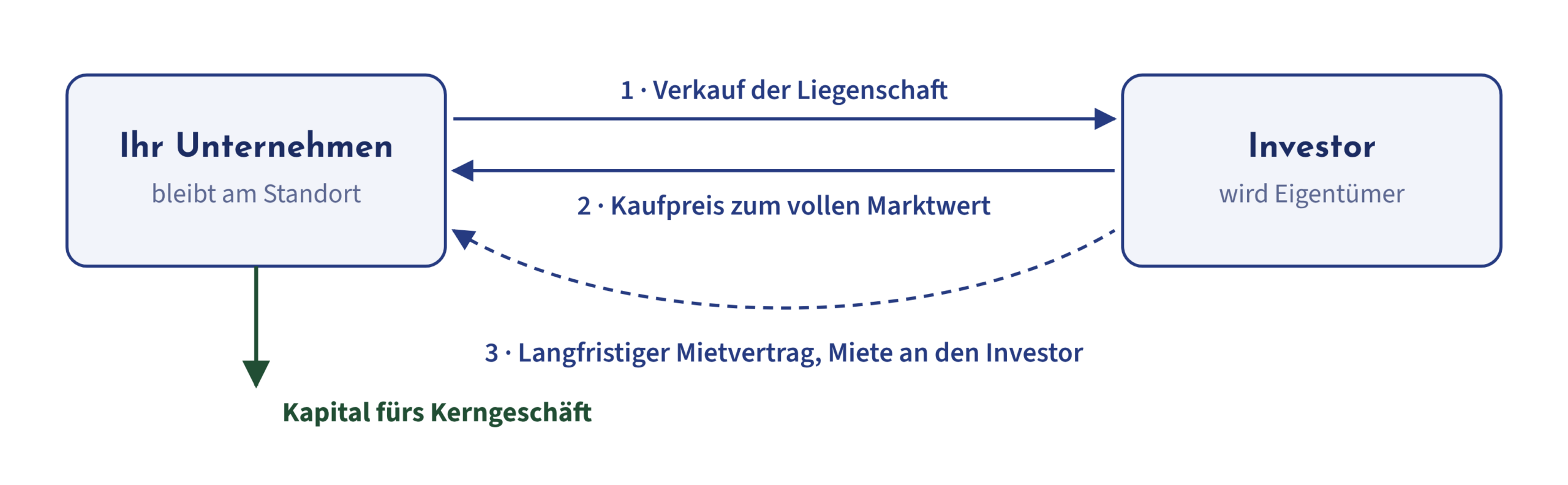
Three features set it apart from conventional debt financing:
Full market value instead of a loan-to-value ratio
A bank finances only part of the value; a sale realizes all of it, including the appreciation in value.
Price and rent are one equation
The purchase price is derived from the capitalised rent. A higher price means a higher rent.
The tenant's credit quality is what the investor buys
Strong credit and a long lease term lower the required yield and raise the price.
Real Life Examples
Two Swiss Transactions in 2026
Purchase price in CHF million
Sale to a listed property fund, September 2026
Year lease term
12 years fixed term,
with the option to extend for up to a further 10 years
Years of a triple-net lease
Second example: production site in Graubünden, two options, each lasting 10 years
How much capital will be freed up? Example based on a market value of CHF 15 million
- Mortgage (example: 60% loan-to-value ratio)60%
- Sale-Leaseback (full market value)100%
At a loan-to-value ratio of 60%, around CHF 9 million will be made available for you to use for your business.
Through the Sale-Leaseback, you will receive the full market value, CHF 15 million, and can use this for investments in your core business, dividends, etc.
How will the interest rate environment in 2026 affect the figures?
The SNB policy rate has been at 0% since June 2025, but long-term financing is becoming more expensive again.
SNB policy rate
unchanged since June 2025
5-year fixed-rate mortgage (average)
+14 basis points since June 2026
10-year fixed-rate mortgage (average)
back above 2 per cent
And the turn in rates may continue: UBS considers an increase in the SNB policy rate in 2027 possible. For owner-occupiers, this means.
- Tied-up equity becomes more expensive. Every franc in the building has to justify itself against what it could earn in the core business or elsewhere.
- Refinancing risk becomes real. A mortgage expiring in 2028 will be repriced in a market no one can foresee today.
- Fix and stabilize occupancy costs, provide investors with table income. Pension funds, insurers and real estate fund want long, indexed cash flows. Companies want certainty, predictability, and budgeting clarity.
Why does a long-term lease provide planning certainty?
A well-negotiated lease is a fixed-price contract for your business.
- Predictable costs. For commercial premises, an index-linked rent based on the Swiss consumer price index is permitted if the lease runs for at least five years. A stepped rent fixes increases in advance for leases of at least three years.
- No refinancing cliff. No loan-to-value tests, no amortisation, no renegotiation with a credit committee, no ongoing reporting to a lender.
- Limited inflation risk. Caps, floors or partial indexation (e.g. 80% of the index) turn an open-ended risk into a bounded one.
- Secure occupancy. Registering the lease in the land register binds every future owner.
- Operational control. Extension options and fit-out and expansion rights secure the control of an owner without tying up an owner's capital.
The flip side: a fixed lease also protects the investor. Lease term and options therefore deserve as much attention as the price.
What are the benefits of a Sale-Leaseback for your company?
Capital for what moves your company forward - without new debt and without giving up the site.
New machinery and equipment
Modernising production, automation, more capacity.
Financial Strength
Debt reduction and a liquidity reserve for uncertain times.
Innovation
Research and Development, new products, digitalisation.
Succession
Separating property can increase the company value
Growth
Acquisitions, tapping into new markets, opening additional sites.
Improve Balance Sheet
More liquid assets, fewer tangible assets – relevant for banks and other stakeholders
What are the risks of a Sale-Leaseback?
- Giving up appreciation: future value gains go to the investor.
- Higher running costs: rent is usually higher than mortgage interest.
- Less flexibility: an early exit becomes expensive.
- Maintenance and capex: under a triple-net lease, the tenant bears maintenance, taxes, insurance and replacement investments.
- Tax realisation: hidden reserves are taxed all at once.
- End of the lease term: without options, you negotiate from a weak position.
None of these risks rules out a transaction; each can be negotiated in the lease before signing.
How does a Sale-Leaseback work – and how do we support you?
A sale and leaseback is not an off-the-shelf product. What matters is that the purchase price and the lease fit your business goals. As real estate advisors, we guide you through the entire process:
Clarify goals:
We discuss with you what the capital should be used for and how long you need the site.
Determine Value
We estimate the market value of your property and show which combinations of price and rent are realistic.
Shape the lease
Term, extension options, rent adjustment and expansion rights. So your business has long-term planning certainty.
Approach investors
We present your property to investors locally, nationally and internationally including pension funds, insurers and real estate funds in a structured process.
Guide the closing
From the buyer's due diligence to notarization, we coordinate all parties, including your fiduciaries and lawyers.
Which company is a Sale-Leaseback suitable for?
Five questions provide an initial orientation. If you answer ‘yes’ to three or more of them, you should have the option assessed. We’d be happy to work with you, with no obligation, to check whether a sale-and-leaseback would be a viable option for your commercial and investment properties.
Please answer the questions to get an initial assessment.
Ownership or Sale-Leaseback?
Compare the costs of retaining your business premises with those of a sale-and-leaseback arrangement. This also takes into account the capital you can invest in your business.
Your assumptions
Keep owning
Capital remains tied up in the property.
- Mortgage interest rates over 15 years
- –
- Maintenance and investment over 15 years
- –
- Total costs over 15 years
- –
- Equity in the property today
- –
- Market value after 15 years, assuming a 1% annual return
- –
- Equity after 15 years, market value minus mortgage
- –
Sale-and-Leaseback
Capital is being channelled into the core business.
- Rent in the first year
- –
- Total costs over 15 years
- –
- Available capital today
- –
- Return on this in the core business, p.a.
- –
Simplified comparative calculation excluding tax and transaction costs. This calculation is not a substitute for individual advice. Assumptions: mortgage with no capital repayment; rent and maintenance costs rise in line with inflation; maintenance costs for the property are borne by the company.
Frequently asked questions about Sale-Leaseback
What is the difference between (1) a sale and leaseback and (2) a mortgage?
A mortgage lends against only part of the property's value and must be refinanced periodically. A sale and leaseback realises the full market value and replaces interest and amortisation with a contractually fixed rent.
What can companies use the released capital for?
Typical uses are new machinery and equipment, automation, research and development, acquisitions, debt reduction or a liquidity reserve – investment in the core business rather than in the building, or a dividend.
What changes for operations after the sale?
Nothing. The company stays on site, with the same employees and equipment. A long-term lease secures occupancy, even if the property later changes owner.
How long is the lease in a sale and leaseback?
In Switzerland, fixed terms of 10 to 20 years are common, supplemented by extension options. You can agree whatever term suits you.
How is the purchase price determined in a Sale-Leaseback?
The purchase price is usually derived from the capitalised rent: annual rent divided by the investor's target yield. The company's credit quality and the lease term have a major influence on the price.
Can the rent be linked to inflation in a Sale-Leaseback?
Yes. For commercial premises, an index-linked rent based on the Swiss consumer price index is permitted if the lease runs for at least five years.
Which properties are suitable for a Sale-Leaseback?
Mainly production and logistics properties, headquarters and operating buildings that are necessary for the business and used over the long term.
What does a Sale-Leaseback mean for your business?
We’ll work with you to assess, with no obligation, whether and how this option would be worthwhile for your commercial and investment property.